Fabrication article
The Fabrication-Ready RFQ: What to Send for an Accurate Sheet Metal or Weldment Quote
Build a fabrication-ready RFQ for laser-cut, formed, welded, and finished metal parts without burying the estimator in unnecessary files.
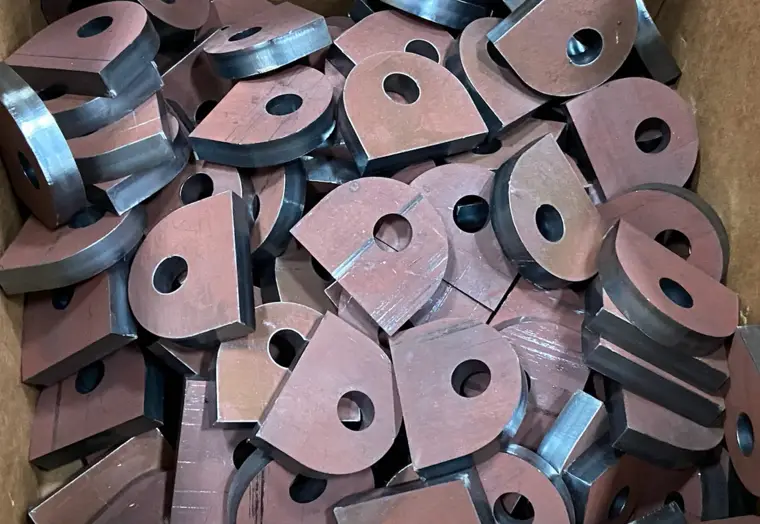
An accurate fabrication quote needs a consistent definition of the part, the work included, and the conditions for acceptance. For a simple flat part, that may be a cut file, material and thickness, quantity, and delivery location. A formed or welded assembly usually also needs a controlled drawing, formed model, bill of materials, finish requirements, and clearly identified critical features.
Short answer: Send the smallest package that completely defines geometry, material, quantity, required operations, critical tolerances, finish, inspection, packaging, and the active revision. State which document controls if the files disagree.
Give each file one job
File Best use STEP or STP Final formed geometry and assembly relationships DXF or DWG Final two-dimensional cut geometry for a flat part PDF drawing Revision, material, dimensions, tolerances, notes, welds, finish, and acceptance Bill of materials Fabricated and purchased items, quantities, and responsibility RFQ scope Quote quantity, timing, ship-to, included operations, records, and packaging
A model shows nominal shape well, but it does not automatically explain whether a hole is tapped, which dimensions are critical after forming, how welds should be finished, or what coating areas must be masked. Those requirements belong in the drawing or scope.
State what controls
Do not make the estimator choose between conflicting files. A useful note is:
The STEP model controls nominal formed geometry. The PDF drawing controls material, tolerances, welds, finish, inspection, and acceptance. Stop and request clarification if they conflict.
Your organization may use a different hierarchy. The important point is to name it.
For a flat laser-cut part
clean final cut geometry with duplicate and construction lines removed;
part number, revision, units, material grade, and thickness;
quantity, destination, and requested timing;
identification of tapped, countersunk, counterbored, reamed, or close-fit holes;
deburring, marking, finish, and packaging requirements.
A circle in a DXF defines a cut profile. It does not automatically define a finished functional hole.
For a formed part
Add the model in its final formed state, finished bend angles, critical formed dimensions, and the datum or measurement condition for important features. Call out required radii only where they are functional, and identify holes or cosmetic surfaces near bends.
Avoid making an unverified flat pattern the only authority. The developed flat depends on material, thickness, tooling, radius, and the forming method.
For a weldment
Add an assembly drawing and complete BOM. Show the final datums and interfaces that matter after welding. Define weld size, length, location, contour, and cleanup using the system required by the project. If a code or inspection requirement applies, identify it precisely rather than using a broad phrase such as “AWS certified.”
Also state whether important dimensions apply as welded, after machining, after coating, or while restrained in a checking fixture.
Do not leave these until after the quote
exact material grade and product form;
coating system, color, masking, and visible surfaces;
certificates, first-article results, or named inspection records;
customer-supplied components;
packaging that prevents scratching, bending, rust, or mixed revisions;
realistic order quantity and release pattern.
Every late requirement can change the process route and price.
A five-question final check
Is the active part and revision unmistakable?
Do the model, drawing, BOM, and RFQ describe the same product?
Are critical interfaces separated from ordinary features?
Does the quote include every operation and record expected at delivery?
Does the fabricator know what to do if two documents disagree?
If the answer is yes to all five, the package is ready for a useful manufacturing conversation.
Send Ahner the current package
Ahner Industrial cuts, forms, welds, and supports repeat-production fabrication from Sandusky, Ohio. Start through the custom quote form, or review Ahner’s laser cutting, forming, welding, and contract manufacturing capabilities.
This guide is a preparation aid. Approved drawings, contracts, codes, and part-specific engineering review control the job.