Fabrication article
How to Move an Existing Fabricated Assembly to a New Supplier Without Losing What Works
A controlled supplier-transfer playbook for welded and formed assemblies covering revisions, deviations, fixtures, first article, pilot run, and release.
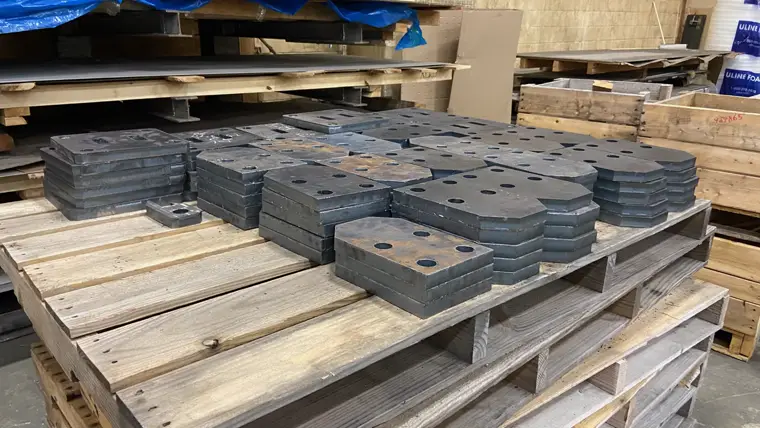
Moving a fabricated assembly is not just a file transfer. It is a controlled re-validation of the product definition, the manufacturing knowledge behind it, and the evidence used to accept it.
Short answer: Rebuild the approved baseline before asking a new supplier to reproduce the part. Include current files, approved deviations, critical features, fixture and inspection information, finish and packaging standards, and real order history. Then use a trial and pilot run before unrestricted production.
Why the drawing may not tell the whole story
Years of production often create knowledge outside the released package. A weld sequence may keep a frame square. A slot may have been widened under an approved deviation. Receiving may use a fixture instead of the free-state dimension. Painted parts may need separators in a specific location.
The old supplier may know these details from experience. The new supplier will not unless the customer captures them.
Treat the sample as evidence, not authority
A “golden sample” can clarify fit, appearance, cleanup, or packaging, but it may also be worn, repaired, hand-fitted, or from an unknown revision. Identify the sample, record its revision and condition, and state exactly what it demonstrates. Define what controls if it conflicts with the released requirements.
Use six controlled gates
1. Establish the approved baseline
Confirm the active drawing, model, BOM, effectivity, permanent changes, temporary deviations, critical features, appearance standard, and open issues. Resolve conflicts rather than asking the new supplier to choose.
2. Rebuild the transfer package
Include assembly and detail files, material and finish requirements, purchased components, inspection history, customer-owned fixtures or gauges, packaging, actual release quantities, and known demand patterns. Separate product requirements from the old supplier’s preferred methods.
3. Conduct a supplier gap review
The new supplier should document missing information, manufacturing assumptions, proposed process changes, tooling needs, outside-process dependencies, inspection concerns, one-time costs, and stop conditions requiring approval.
4. Run a trial or first article
Agree on the exact revision, dimensions, materials, weld or finish evidence, functional checks, sample comparison, and packaging trial. A first article shows that the documented process can produce an acceptable item; it does not prove sustained production rate.
5. Run a pilot lot
Use a quantity large enough to expose fixture loading, distortion, repeatability, inspection workload, finish consistency, labeling, packaging, and throughput. A pilot should resemble the way the part will actually be ordered.
6. Release and stabilize production
Record the approved baseline, close or control every trial deviation, define early-lot inspection, manage old-revision inventory, and assign engineering, quality, and delivery escalation owners.
Stop if the baseline is unclear
Pause the transfer when the model, drawing, sample, and inspection report show different revisions; a critical feature has no agreed measurement method; tooling ownership is unknown; or an operation performed by the old supplier is missing from the quote.
These are solvable gaps. They are expensive only when discovered after production begins.
Discuss a controlled transition
Ahner Industrial supports repeat-production laser cutting, forming, welding, and contract manufacturing. Start through the custom quote form with the current package, known history, quantities, and transfer objective.
This guide does not replace an OEM supplier-quality procedure, contract, approved drawing, regulatory obligation, or engineering authority.