Metal fabrication capability
Laser Cutting
Get precision laser cutting from Ahner Industrial in Sandusky, Ohio. Upload DXF, STEP, or STP files for online pricing on commercial sheet metal parts.
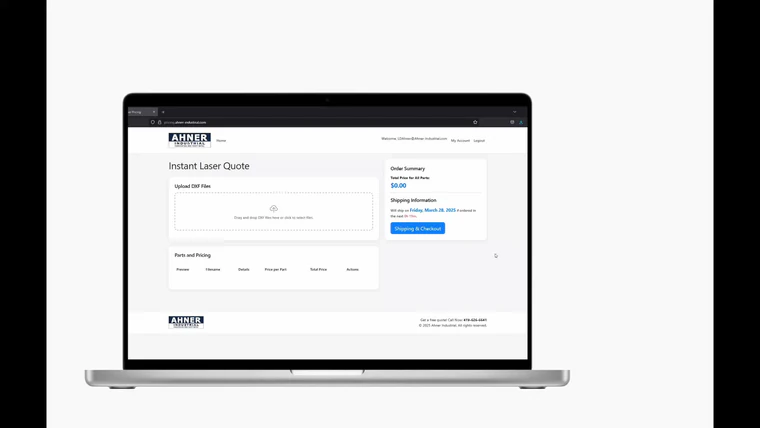
Transform Your Ideas into Precision-Cut Reality
Ahner Industrial laser cuts sheet and plate for prototypes, replacement parts, and production components. Project review considers material, thickness, part size, geometry, tolerances, edge requirements, quantity, and downstream forming or welding before the manufacturing route is confirmed.
Trumpf Fiber Laser
Ahner operates a Trumpf 3040 fiber laser for sheet and plate work across the published material and size ranges below. Those limits are capability references rather than automatic quote approval; material grade, geometry, tolerance, edge condition, stock availability, and downstream operations are reviewed for each part.
Published cutting capability references include:
• Published Trumpf steel reference: sheet and plate up to 1 inch thick, with dimensions up to 78" x 157". Actual process fit is reviewed for the part.
• Published Trumpf stainless-steel reference: sheet and plate up to 1.5 inches thick, with dimensions up to 78" x 157". Actual process fit is reviewed for the part.
• Published Trumpf aluminum reference: sheet and plate up to 1 inch thick, with dimensions up to 78" x 157". Actual process fit is reviewed for the part.
Copper, brass, and other specified metals can be submitted for a cutting review. The exact grade, thickness, geometry, edge condition, quantity, stock availability, and downstream work determine the appropriate manufacturing route.
Laser cutting can support one-off parts, prototypes, repeat blanks, and production quantities. Achievable tolerance, edge condition, lead time, and process selection depend on the material, thickness, geometry, quantity, and downstream requirements shown on the drawing or CAD model.
Mitsubishi Laser
Mitsubishi Laser & Messer Plasma
Ahner also operates a Mitsubishi laser cutting system. Selection among fiber laser, CO₂ laser, plasma, and oxy-fuel cutting depends on material, thickness, part size, geometry, edge requirements, tolerance, quantity, and downstream fabrication—not a universal speed or quality claim.
Published Mitsubishi cutting capability references include:
• Published Mitsubishi steel reference: sheet and plate up to 1 inch thick, with dimensions up to 60" x 120". Actual process fit is reviewed for the part.
• Published Mitsubishi stainless-steel reference: sheet and plate up to 3/4 inch thick, with dimensions up to 60" x 120". Actual process fit is reviewed for the part.
• Published Mitsubishi aluminum reference: sheet and plate up to 1/2 inch thick, with dimensions up to 60" x 120". Actual process fit is reviewed for the part.
Specialty alloys and nonmetal materials require a separate process review. Send the exact grade or composition, thickness, geometry, edge and finish requirements, and quantity so Ahner can confirm whether the work fits an available cutting process. Standard metal-cutting or online-quote compatibility should not be assumed.
Ahner offers CNC plasma cutting for sheet and plate and oxy-fuel cutting for thicker carbon-steel plate. Material, thickness, geometry, cut features, tolerance, edge condition, thermal effects, and downstream operations determine the route. Any cleanup or machining needed for the finished part is included in the project review.
Published plasma and oxy-fuel capability references include:
• Published CNC plasma steel reference: sheet and plate up to 1 inch thick, with dimensions up to 96" x 218". Actual process fit is reviewed for the part.
• Oxy-fuel cutting of carbon-steel plate up to 4 inches thick, with published dimensions up to 96" x 218". Actual process fit is reviewed for the part.
Plasma cutting of stainless steel, aluminum, copper, or another specified metal requires review of the exact material, thickness, geometry, cut quality, and downstream requirements. Oxy-fuel cutting is used for carbon-steel plate; it is not a shared compatibility claim for those other metals.
Laser and Plasma Cutting FAQ
Q: What laser cutting machines does Ahner Industrial use? A: Ahner operates a Trumpf 3040 fiber laser and a Mitsubishi laser cutting system. The shop selects equipment after reviewing material, thickness, part size, geometry, tolerance, edge requirements, quantity, and downstream operations.
Q: How do the Trumpf 3040 and Mitsubishi laser machines differ? A: The Trumpf fiber laser and Mitsubishi laser use different machine configurations and process characteristics. Ahner assigns work based on the actual material, thickness, geometry, edge requirement, tolerance, quantity, and production route rather than treating either machine as universally better.
Q: What are the cutting capabilities of your laser machines? A: Published Trumpf 3040 fiber-laser references are steel up to 1 inch, stainless steel up to 1.5 inches, and aluminum up to 1 inch, with dimensions up to 78 by 157 inches. Published Mitsubishi laser references are steel up to 1 inch, stainless steel up to 3/4 inch, and aluminum up to 1/2 inch, with dimensions up to 60 by 120 inches. These are capability references; actual material grade, geometry, tolerance, edge condition, stock, and downstream work require project review. Other materials are reviewed separately.
Q: What plasma cutting solutions does Ahner Industrial offer? A: Ahner offers CNC plasma cutting for sheet and plate and oxy-fuel cutting for thicker carbon-steel plate. The drawing, material, thickness, cut features, edge requirements, tolerance, and downstream operations determine the process and any cleanup or machining required.
Q: What are the capabilities of your plasma cutting services? A: Published CNC plasma references include steel sheet and plate up to 1 inch thick with dimensions up to 96 by 218 inches. Published oxy-fuel references include carbon-steel plate up to 4 inches thick with dimensions up to 96 by 218 inches. Actual capacity and cut quality are reviewed for the part. Stainless steel, aluminum, copper, and other specified metals require a separate plasma-process review; the oxy-fuel reference applies to carbon steel.
Q: How do I decide whether to use laser or plasma cutting? A: Laser, plasma, and oxy-fuel cutting suit different combinations of material, thickness, part size, geometry, tolerance, and edge requirements. Send the drawing or CAD model so Ahner can review the practical process for the part and any downstream forming, welding, or machining.
Q: How can the available cutting processes benefit my project? A: Matching the cutting process and nesting strategy to the part can improve material use, repeatability, and production flow. Actual lead time, tolerance, edge condition, and cost depend on the complete part and order requirements.
Get a Quote for the Finished Part
Send the material grade and thickness, quantity by part number, and current drawing revision with your DXF or STEP file. Identify tapped holes, machined features, visible surfaces, and tolerances that the model alone does not explain.
Production-ready CAD for supported laser-cut or formed sheet metal parts can start in online pricing. For welding, assembly, unsupported geometry, or an unresolved design detail, send the complete requirement for manufacturing review.